Optical channel
High-capacity laser transmission and reception in telecom wavelengths, engineered for integration constraints.
 SpaceDrone-DataLinkOptical Connectivity
SHC PLATFORM
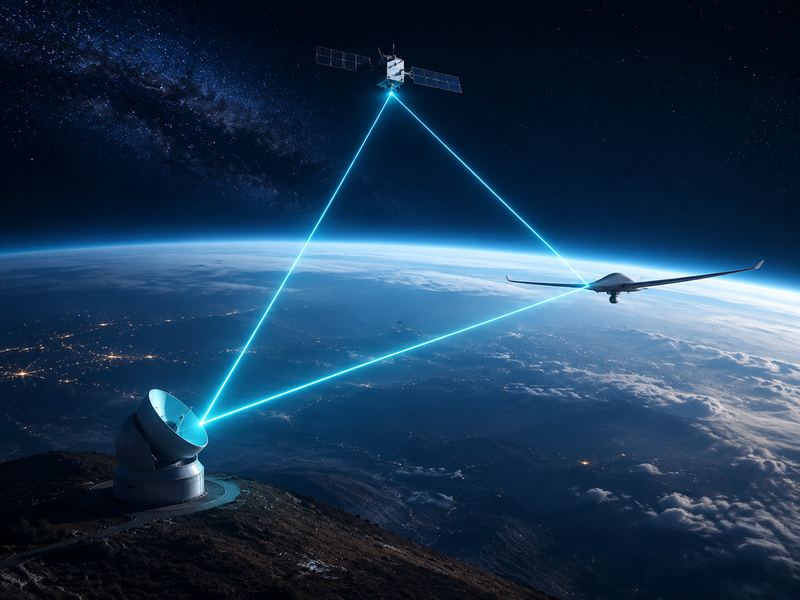
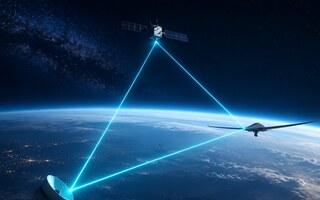
SHC combines a laser link, a backup radio link and artificial-intelligence software installed in the terminal. The software monitors communication quality and helps the system keep the best available connection.
FUNCTIONAL ARCHITECTURE
Value does not come from an isolated component but from system coherence, from link establishment to integration into customer infrastructure and operational workflows.
High-capacity laser transmission and reception in telecom wavelengths, engineered for integration constraints.
Acquisition, alignment and link maintenance between mobile or orbital platforms.
Adaptive management of availability, switching and service continuity.
Reception, supervision, security, processing and connection to data infrastructure.
INTEGRATED PHOTONICS
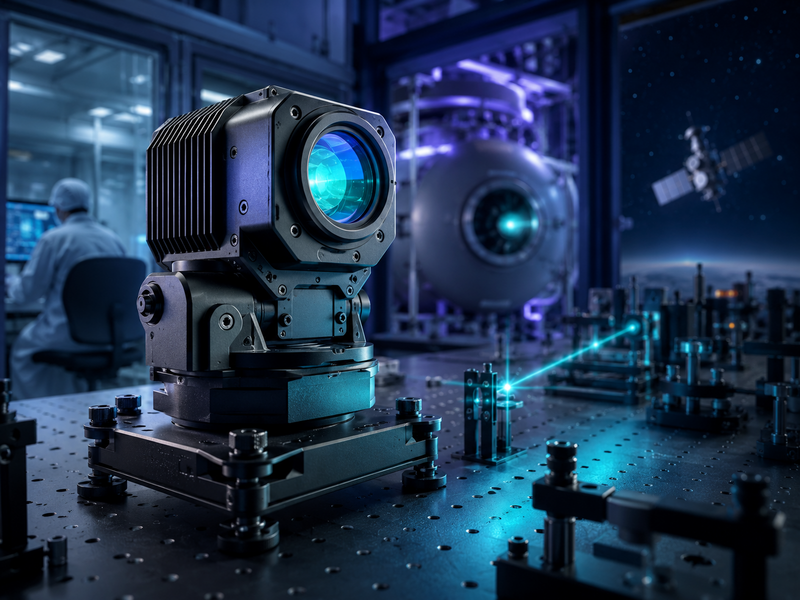
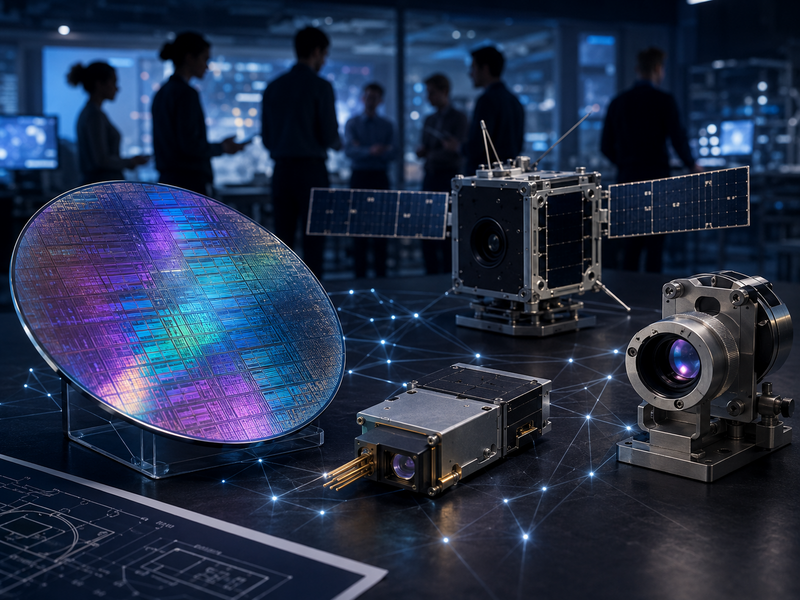
The programme brings photonic components, high-speed electronics, processing and pointing control into one integration approach. Validation progresses by building block before converging into representative, measurable and repeatable demonstrators.
EMBEDDED AI, EXPLAINED SIMPLY
In practical terms, AI is software installed directly in the SHC terminal. It monitors signal quality, platform movement and equipment health. It then helps the system apply the most appropriate predefined action quickly, without always waiting for an instruction from the ground.
AI helps the terminal remain pointed at its target despite movement, vibration or a change of course.
If the laser link is temporarily unavailable, the system can use radio and return to laser when conditions improve.
When capacity is limited, alerts and priority data can be sent before less urgent information.
The system identifies unusual behaviour earlier and alerts the operator before a possible service interruption.
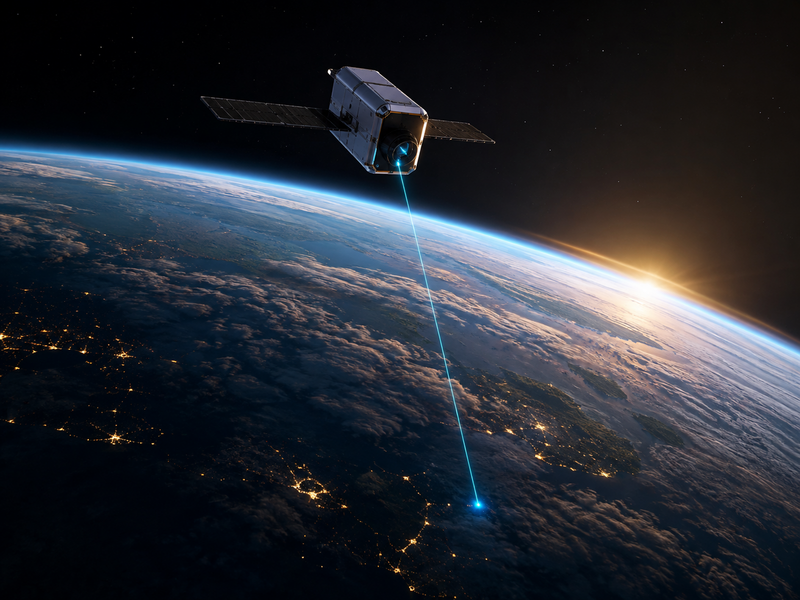
A satellite encounters cloud cover that weakens its laser link. SHC can keep priority messages moving by radio, monitor the return of good conditions and then resume the high-capacity laser link.
What AI does not do: it does not decide the mission on its own. It operates within predefined limits, the operator retains oversight and conventional operating modes remain available.
EMBEDDED CYBERSECURITY AND CRYPTOGRAPHY
Protection is built into the SHC terminal and remains active whether communication uses laser or radio. For a user, this means intercepted data remains unreadable, the terminal verifies the equipment it is communicating with and a modified message can be detected before it is used.
Without the expected authorisation, intercepted information remains unintelligible.
Each terminal checks that it is communicating with the expected equipment, not an intruder.
The recipient can verify that the message was not altered while in transit.
At startup and during updates, the system checks that only authorised software is executed.
If SHC temporarily switches from laser to radio to maintain service, data protection remains active throughout the transition.
Security principle: use recognised and proven mechanisms, never store keys in clear text and allow them to be renewed. Algorithms, key organisation and detailed technical parameters are not published on this website.
SOVEREIGNTY AND ITAR-FREE OBJECTIVE
SpaceDrone-DataLink prioritises a European architecture, components and partners to limit reliance on technologies subject to ITAR. ITAR-free status is claimed only after documentary verification of every component, software item and item of technical data.
Identify the manufacturer, country of origin and export classification of critical items.
Plan a European option whenever foreign dependency could restrict use or export.
Keep sensitive documentation, keys and access within a controlled European framework.
Recheck classifications and supplier statements whenever the configuration changes.
Compliance point: ITAR-free does not mean free from all export rules. Any applicable EAR, European and French constraints remain assessed for the configuration and destination concerned.
DESIGN PRINCIPLES
Mass, volume, power and cost treated as architecture parameters.
Exchange protection and data governance integrated from inception.
Validation across components, subsystems, demonstrators and representative environments.
Technology choices, packaging, metrology and supply chain anticipated.
PUBLIC PROOFS